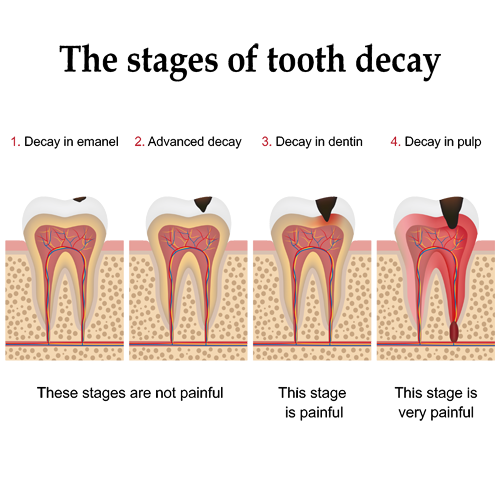
Tooth decay happens because bacteria (germs) that live in our mouths use sugar from
the food we eat. When these bacteria use the sugar, they make acid. Over time, the
acid can cause cavities (or holes) in teeth.
 Schedule Appointment
What is tooth decay?
Is my child at risk for tooth decay?
Tooth decay is one of the most common childhood diseases. Almost 1 in 2 children
will have decay in their baby teeth.
Your child’s first teeth (or baby teeth) are important. Baby teeth hold space for
adult teeth. Take care of your child’s teeth to protect your child from tooth decay
(cavities).
Tooth decay can cause your child pain, Make it hard for your child to chew, Make
your child embarrassed to talk or smile, Create problems for your child’s adult
teeth.
How to Prevent Cavities
Cavities happen when bacteria and food left on the teeth after eating are not brushed
away. Acid collects on a tooth, softening its enamel until a hole or cavity forms.
- Start good oral habits early. Teach kids to brush at least twice a day with fluoride
toothpaste and to floss regularly.
- Get enough fluoride. Regular use of fluoride toughens the enamel, making it harder
for acid to penetrate. Although
many towns require tap water to be fluoridated,
others don't. If your water supply is not fluoridated or if your family
uses purified
water, ask your dentist for fluoride supplements. Be careful, however, since too
much fluoride can cause
tooth discoloration. Check with your dentist before supplementing.
Most toothpaste
contains fluoride but toothpaste alone will not fully protect a
child's teeth.
- Limit or avoid certain foods. Sugary foods, juices, candy (especially sticky gummy
candy, gummy vitamins, or fruit
leather or "roll-ups") can erode enamel and cause
cavities. If your kids eat these foods, have them rinse their mouth
or brush their
teeth after eating to wash away the sugar. The same goes for taking sweetened liquid
medicines:
always have kids rinse or brush afterward.
As your child's permanent teeth grow in, the dentist can help prevent decay by applying
a thin wash of resin (called a sealant) to the back teeth, where most chewing is
done. This protective coating keeps bacteria from settling in the hard-to-reach
crevices of the molars. But make sure that kids know that sealants aren't a replacement
for good brushing and regular flossing.
Does Diet Affect My Child's Teeth?
Yes. Avoiding sweets, sticky foods and between-meal snacks is good advice. To avoid
cavities, limit sweet snacks and drinks between meals. Have meals and snacks at
regular times. Teeth-friendly snacks include foods such as fresh fruits and vegetables.
Baby bottles can create additional problems with your child's dental health. When
liquid from a bottle,like milk and juice stays in contact with the teeth for a
long time, the sugars cause tooth decay. This can create a condition called bottle
mouth. Your baby's teeth can develop cavities and become pitted or discolored. Never
put a baby to bed with a bottle. Don't let your child walk around during the day
with a bottle, and teach your child to use a drinking cup around his or her first
birthday.
Make sure your child has a balanced diet including one serving each of: fruits and
vegetables, breads and cereals, milk and dairy products, and meat fish and eggs.
Limiting the servings of sugars and starches will aid in protecting your child's
teeth from decay. You can ask us to help you select foods that protect your children's
teeth.
Third, the dentist is able to educate parents and children during the visit. Sometimes
the dentist wants to introduce one or several factors to enhance tooth health -
for example, sealants, fluoride supplements, or xylitol. Other times, the dentist
asks parents to change the child’s dietary or oral behavior - for example, reducing
sugar in the child’s diet, removing an intraoral piercing, or even transitioning
the child from sippy cups to adult-sized drinking glasses.
Baby Bottle Tooth Decay
Baby bottle tooth decay (also called early childhood caries, nursing caries, and
nursing bottle syndrome) happens when a baby's teeth are in frequent contact with
sugars from drinks, such as fruit juices, milk, formula, fruit juice diluted with
water, sugar water, or any other sweet drink. If breastfed infants fall asleep with
swallowed milk in their mouths, they are also at risk for tooth decay. Bacteria
in the mouth feed on the sugars, causing tooth decay.
If left untreated, decayed teeth can cause pain and make it difficult to chew and
eat. Also, baby teeth serve as "space savers" for adult teeth. If baby teeth are
damaged or destroyed, they can't help guide permanent teeth into their proper position,
possibly resulting in crowded or crooked permanent teeth. Badly decayed baby teeth
could lead to an abscessed tooth, with the possibility of infection spreading elsewhere
in the body.
How Do I Prevent Baby Bottle Tooth Decay?
Some tips to prevent baby bottle tooth decay include:
- During the day, to calm or comfort your baby, don't give a bottle filled with sugary
drinks or milk; instead, give plain water or a pacifier.
- Never dip your baby's pacifier in sugar, honey, or any sugary liquid.
- Don't put your baby to bed with a bottle filled with sugary drinks (watered-down
fruit juice or milk still increases the risk of decay). Give a small amount of plain
water or use a pacifier instead. Too much water is harmful to a baby.
- If your baby is nursing at night, make sure you remove your breast from your baby's
mouth when she falls asleep.
- Don't add sugar to your baby's food.
- Use a wet cloth or gauze to wipe your baby's teeth and gums after each feeding.
This helps remove any bacteria-forming plaque and sugar that have built up on the
teeth and gums.
- Ask your dentist about your baby's fluoride needs. If your drinking water is not
fluoridated, fluoride supplements or fluoride treatments may be needed.
- Teach your baby to drink from a cup by his or her first birthday. Moving to a "sippy
cup" lowers the teeth's exposure to sugars, but constant sipping from the cup can
still result in decay unless it is filled with plain water.
Call us at 703-743-2324 for an appointment and visit us at Gainesville Dental Arts
in Gainesville, Haymarket Virginia for more information and let us help you to protect
your child’s teeth from cavities.