Although in an ideal world we wish the permanent teeth to last a lifetime, but unfortunately
the teeth that have become damaged due to trauma, tooth decay or gum disease may
need to be removed or extracted. Despite our best efforts to save a tooth, sometimes
extraction is the only alternative.
Factors leading to extraction include:
- Extensive trauma
- Substantial tooth decay
- Gum Disease
- Badly cracked or broken teeth
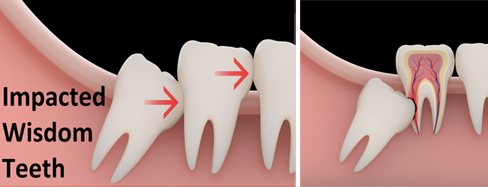
- Wisdom teeth that are impacted or placed at an angle that may damage the adjacent
teeth.
At times there may be some other reasons to remove the teeth at your dentist’s recommendation.
Other reasons include:
A crowded mouth: Sometimes the teeth may need to be removed in order to prepare
the mouth for orthodontic treatment. The goal of orthodontics is to properly align
the teeth resulting in a pleasant smile and ideal occlusion, which may not be possible
if you have big teeth in a small mouth if a tooth cannot break through the gum (erupt)
and has become impacted within the jaw bone because there is not enough room in
the mouth for it, then removal of tooth may be recommended.
Infection: If tooth decay or damage extends to the pulp -- the center of
the tooth containing nerves and blood vessels bacteria in the mouth can enter
the pulp, leading to infection. If infection is so severe that antibiotics do not
cure it, extraction may be needed to prevent the spread of infection.
Risk of infection: If your immune system is compromised (for example, if
you are receiving chemotherapy or are having an organ transplant) even the risk
of infection in a particular tooth may be reason to remove the tooth.
Gum disease: If periodontal disease -- an infection of the tissues and bones
that surround and support the teeth have caused loosening of the teeth, it may
be necessary to extract the tooth or teeth.
The idea of having a tooth extracted is scary for some. Don’t worry though, with
our gentle and pain-free methods, you have nothing to fear. We here at Gainesville
Dental Arts are committed to providing you the most comfortable, pain-free procedure
possible
What to expect with tooth extraction
Dentists and oral surgeons (dentists with special training to perform surgery) perform
tooth extractions. Before removing the tooth, you will be given an injection of
a local anaesthetic (or pain medicine) to numb the area where the tooth will be
removed. If you are having more than one tooth extracted or a tooth is impacted,
we may use a general anaesthetic, this will prevent pain throughout your body and
make you sleep through the procedure.
Once the tooth has been extracted, a blood clot usually forms in the socket. The
dentist will pack a gauze pad into the socket and get you to bite down on it to
help stop the bleeding. Sometimes the dentist will place a few stitches -- usually
self-dissolving -- to close the gum edges over the extraction site.
No one likes the idea of losing a tooth; however, there are options we can provide
to fill the empty space or replace the missing tooth, such as:
- Implants
- Implant retained dentures, which look and feel like normal
teeth
- Traditional dentures
- Dental bridges, which are three or more porcelain teeth fused
together
Wisdom Tooth Extractions
Wisdom teeth, also known as your "third molars" usually come in between the ages
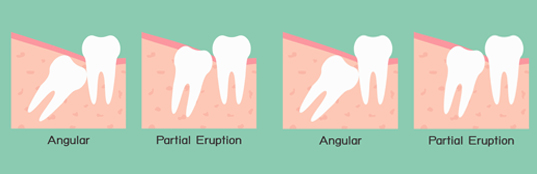
of 17 - 24. Many times they come in only partially, sideways or impacted due to
limited space in your mouth. If this occurs, your wisdom teeth may need to be extracted.
Do all wisdom teeth need to be extracted?
It is not always necessary to extract all wisdom teeth. If a person brushes, flosses,
and keep these teeth clean regularly they usually don’t need to have a wisdom tooth
or teeth removed.
However, if the wisdom tooth doesn’t break through the gums, as it normally should
do. The wisdom tooth can become partially erupted through the gingival tissue, and
if this does happen, it is then called for a wisdom teeth extraction to take place.
This is because this partially erupted wisdom tooth can be the source of inflammation
and infection. When the wisdom tooth is partially erupted in the gingival tissue
this way the tooth can form a soft tissue layer growth called the operculum. The
operculum can trap bacteria up underneath it and this can lead to an infection called
pericoronitis.
Pericoronitis is inflammation of the gums that is surrounding the crown of the tooth.
This infection can be one of two things. Chronic or recurrent is a mild infection
that does come back. Acute pericoronitis is much worse and can cause fever, swelling,
and also pain that is a sign that the infection is spreading. Having pericoronitis
is surely one of the most common reasons an emergency wisdom tooth extraction does
take place.
Symptoms of this infection do include the presence of very red and inflamed gums,
pain being present when biting down on back teeth, bad taste in mouth or smell,
and sometimes pus draining or oozing out from infected area. Swelling of the gum
tissue, cheek, or other area that is in location of the afflicted side of the jaw.