A denture is a removable replacement for missing teeth and surrounding tissues.
Two types of dentures available are, complete and partial dentures. Complete dentures
are used when all the teeth are missing, while partial dentures are used when some
natural teeth remain.
 Schedule Appointment
Complete Dentures
Complete dentures can be either "conventional" or "immediate."
Made after the removal of the teeth when the gum tissue has begun to heal, a conventional
denture is ready for placement in the mouth about eight to 12 weeks after the teeth
have been removed.
Unlike conventional dentures, immediate dentures are made in prior to the removal
of teeth and can be positioned as soon as the teeth are removed. As a result, the
denture wearer does not have to be without teeth during the healing period. However,
bones and gums shrink over time, especially during the healing period following
tooth removal. Therefore a disadvantage of immediate dentures compared with conventional
dentures is that they require more adjustments to fit properly during the healing
process and generally should only be considered a temporary solution until conventional
dentures can be made.
Premium Dentures
Custom Characterized dentures are ideal for you if you desire exclusive features
and the best value. This option provides the ultimate way to create more natural-looking
teeth.
Premium Dentures Include:
- Top Quality acrylic base plate for more natural looking gums
- Options for whiter shades of teeth and improved odor resistance
- Shrink-free process for a more comfortable, confident and secure fit
- Replacement "Safety" denture (extra set)
- Free annual check-up with oral cancer screening and professional cleaning
- Free reline in first 3 years, if necessary
Valplast Flexible Partial Dentures
Not only does a partial denture fill in the spaces created by missing teeth, it
prevents other teeth from changing position. When you are ready to replace missing
teeth you have a number of potential solutions available, each with its own set
of advantages and disadvantages.
Replacing your missing teeth is a big decision and it is important to consider several
factors. You don’t have to make this decision alone. Your dentist can help you assess
the choices in light of your clinical needs, personal preferences and financial
considerations and help you determine which one is best for you. Choose what you
want to eat, not what your teeth will let you eat!

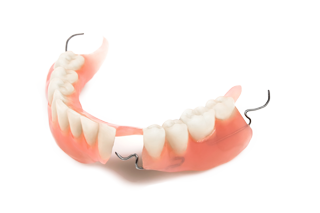
Valplast® flexible partials could be the solution for you to replace one or more
teeth. Unlike more traditional ridged, bulky and unstable dental materials Valplast
flexible partial denture are made from a flexible plastic material which fits neatly
into your mouth and is virtually invisible. They do NOT require any unsightly metal
clasps to keep them in place.
Most Valplast Flexible Partials are fabricated without the use of a metal frame
- made instead from a strong, durable plastic that snaps securely and comfortably
into place around your existing teeth.
The plastic used is so strong that the partial dentures made from it can be very
thin, eliminating that heavy, bulky feeling that made wearing partials so unpleasant
in the old days. As it is very thin it picks up the characteristics of the underlying
tissue.
Flexible Partials blend in well with the natural appearance of your gums, making
the partial virtually invisible.
How Are Dentures Made?
The denture development process takes a few weeks and several appointments. Once
we determine what type of appliance is best for you, the general steps are to:
- Make a series of impressions of your jaw and take measurements
of how your jaws relate to one another and how much space is between them.
- Create models, wax forms, and/or plastic patterns in the exact
shape and position of the denture to be made. You will
"try in" this model several
times and the denture will be assessed for color, shape, and fit before the final
denture is
cast.
- Cast a final denture.
- Adjustments will be made as necessary.
Getting Used to Your New Dentures
Some patients find the experience of wearing a denture for the first time to be
challenging. A denture is a foreign object, it may not duplicate the exact feel
and function of your natural teeth. Initially it will be a new sensation that will
take you a period of time to adjust.
Time, Patience & Will Power
New dentures can be a somewhat trying experience for some patients. Dentures often
will feel strange and bulky and will cause a feeling of fullness of the lips and
cheeks. In time, these feelings will subside and you will feel more comfortable.
Time, patience and will power are your biggest allies.
Other Symptoms
You may also experience slurred speech, gagging, excessive salivation and funny
or diminished taste. Again, these issues usually disappear over time. However, if
they continue, please contact our office to let the dental staff know about your
particular difficulty. We’re here to help you!
Learning to Chew with Your New Dentures
It is especially difficult to adjust to a lower denture, because it "floats" on
your lower gums and will not have the suction that your upper denture has. It will
move around in your mouth, even out of your mouth, until you have mastered it.
Lower Denture Challenges
New dentures can be a somewhat trying experience for some patients. Dentures often
will feel strange and bulky and will cause a feeling of fullness of the lips and
cheeks. In time, these feelings will subside and you will feel more comfortable.
Time, patience and will power are your biggest allies.
Try resting your tongue against the inside, front edge of the lower denture to help
hold it in place. Until you learn good tongue and lip control, adhesives are recommended.
Adhesives may also be useful for upper dentures. If you are an existing denture
wearer and have become accustomed to adhesives, you most likely will have to continue
using adhesives for your dentures.
Caring for Your Dentures
Daily care and cleaning of your dentures is very important to help keep them looking
their best and prevent stains and denture odor. For everyday cleaning, use a soft
brush and a cleaning agent, such as soap and water, or products sold especially
to clean dentures. Be sure to brush both the inside and outside of your denture.
This will help eliminate harmful bacteria. We also suggest soaking your denture
in water or a denture cleaning agent when you take them out at night.
To help prevent breakage in the event you accidentally drop your dentures while
cleaning them, we strongly recommend that you hold them over a sink filled with
water. You may also want to cushion the sink and counter with a soft cloth or towel.
Are There Alternatives to Dentures?
Yes, dental implants can be used to support cemented bridges, eliminating the need
for a denture. The cost is usually greater, but the implants and bridges more closely
resemble the feel of real teeth. Dental implants are becoming the alternative to
dentures but not everyone is a candidate for implants. Consult Dr. Kaur for advice.
What Do New Dentures Feel Like?
New dentures may feel a little odd or loose for a few weeks until the muscles of
the cheeks and tongue learn to keep them in place and you get comfortable inserting
and removing them. Also, it is not unusual for minor irritation or soreness to occur
and for saliva flow to increase when you first start wearing dentures, but these
problems will diminish as the mouth adjusts.
Will Dentures Make Me Look Different?
Dentures are made to closely resemble your natural teeth so there should be only
a small noticeable change in appearance. In fact, dentures may even improve your
smile and fill out your facial appearance.
Will Dentures Change How I Speak?
After getting dentures, you may have difficulty pronouncing certain words. If so,
practice by saying the difficult words out loud. With practice and with time you
will become accustomed to speaking properly with dentures.
If dentures "click" while you're talking, contact us at Gainesville Dental Arts.
Dentures may occasionally slip when you laugh, cough, or smile. Reposition the dentures
by gently biting down and swallowing. If any speaking problem persists, consult
Dr. Kaur.
Are Dentures Worn 24 Hours a Day?
We will instruct you as to how long to wear dentures and when to remove them. During
the first several days after receiving your denture, you may be asked to wear it
all the time, including while you sleep. Although this may be temporarily uncomfortable,
it is the quickest way to identify the areas on the denture that may need adjustment.
Once adjustments are made, you should remove dentures before going to bed. This
allows gum tissues to rest and allows normal stimulation and cleansing by the tongue
and saliva. The denture can be put back in the mouth in the morning.
For more information on dentures or to schedule an appointment, call Gainesville
Dental Arts in Gainesville, Haymarket Virginia.