Ideal for protecting a cracked, broken tooth or covering up tooth discolorations,
crowns can be a great solution for improving your smile.
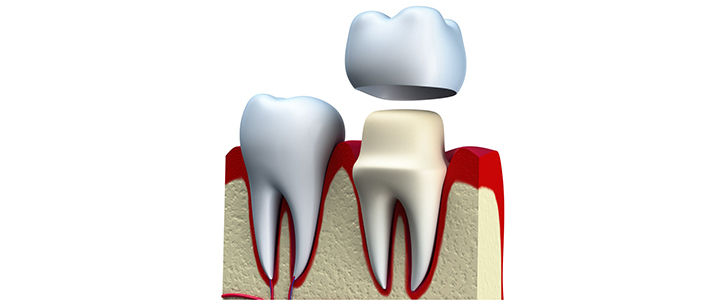
The anatomy of a tooth can be divided into two basic parts -- the root and the crown.
In a person with healthy gums and bone, the root of the tooth is covered by the
gums and bone. The part of the tooth that is visible in the mouth, above the gum
line on lower teeth and below the gum line on upper teeth, is called the clinical
crown. A cemented restoration that partially or completely covers the outside of
the clinical crown is referred to as a dental crown or cap.
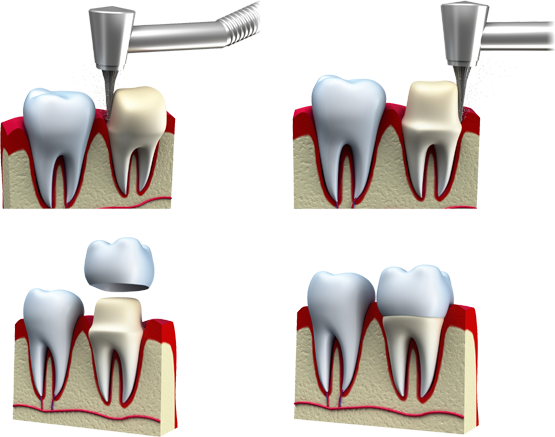
A crown is a tooth shaped cap that fits over a problem tooth to improve strength,
size and appearance
The crown procedure is relatively simple. First we will anesthetize the problem
tooth area. Once completely numb, the tooth is filed down so that the crown fits
appropriately. Then, we will take an impression of the tooth to use in the construction
of the crown.
The impressions are sent away to a dental laboratory to create your crown; meanwhile,
we apply a sturdy temporary crown over the problem tooth while your permanent crown
is manufactured. Once your permanent crown is ready, you will come back to Gainesville
Dental Arts and the crown will be inserted. Now you have a bright, healthy-looking
new tooth!
Crown placement can offer several benefits:
- Long term durability
- Protection from further decay, infection and cracking
- Improved chewing and talking
- An improved, natural and healthier smile
When is a dental crown needed?
Large filling: When a tooth has a cavity or fracture that involves half the
width of the tooth or more, it needs to be covered with a crown. This is because
the remaining tooth around the large filling is so weak that it is prone to fracture.
Sometimes a large filling that has been in the mouth for a while will need to be
replaced with a crown because the tooth shows signs of stress and cracks around
the filling.
Root canal: Root canal treatment leaves the tooth hollowed out and predisposes
the remaining tooth to cracking. So, a tooth that has had a root canal almost always
needs to be restored with a crown immediately to prevent it from fracturing.
Cracked tooth syndrome: This is a condition whereby a patient has fractures
inside a tooth that cause pain when it is chewed on a certain way. Chewing produces
stress on fracture lines that make it feel like it is splitting apart. A crown will
hold the tooth together and redistribute the stress evenly throughout the tooth,
eliminating the pain in most instances. In these situations, it is best to leave
a temporary crown on for a while to make sure the pain goes away and the tooth doesn't
require a root canal.
Broken cusps: Cusps frequently break off of teeth due to trauma or large
existing fillings. Since the cusps are the part of the tooth that takes the most
stress during chewing, they need to be completely covered or the tooth or filling
will keep fracturing. Sometimes the tooth breaks all the way to the bone, and a
crown-lengthening procedure is necessary. This means the bone and gums need to be
trimmed down below the edge of the fractured part of the tooth so the margin of
the crown can be placed on healthy, strong tooth structure.
Excessive wear of teeth: If a person has a habit of grinding their teeth,
the teeth will become shorter over time. The teeth can also wear away due to acid
erosion caused by gastrointestinal acid reflux(GERD), bulimia, or an acidic diet.
Sometimes, the enamel will wear away completely, leaving small, soft teeth. Over
time, the bite can collapse and the only way of restoring the teeth properly is
by increasing the bite and covering the teeth with crowns.
Undesirable appearance of teeth: Teeth that have an unacceptable appearance
due to color, shape, or spaces between teeth can be made to look very natural and
beautiful with crowns. Dental veneers are a very effective and conservative way
of enhancing the look of the front teeth. They can be made to look very natural,
and sometimes they don't even require preparing or shaving the existing teeth.
Other: Crowns are placed on dental implants to restore spaces left from missing
teeth. Another way of filling these spaces is with dental bridges, which are made
from crowns on the teeth next to the spaces attached to fake teeth in the middle.
If teeth are loose, crowns can be placed on multiple teeth and splinted together
to provide more stability.
What types of dental crowns are available?
Crowns can be made out of a gold alloy, some other metal alloy, stainless steel,
all-porcelain/all-ceramic, composite resin, zirconia, or porcelain on the outside
fused to metal or zirconia on the inside. In some cases, ceramic crowns can be made
with CAD/CAM technology by milling the crowns out of blocks of porcelain in the
dental office, without the need for temporaries or a dental laboratory. There are
advantages and disadvantages to all of the types of dental crowns. Stainless steel
crowns are preformed crowns used to cover baby teeth for children. Gold dental crowns
have traditionally been the most durable and require less of the tooth to be removed
or shaved down. The primary advantage of porcelain crowns is their esthetics, while
newer types of ceramic crowns have become increasingly more durable.
Benefits of Crown
- Long term durability
- Protection from further decay, infection and cracking
- Improved chewing and talking
- An improved, natural and healthier smile